
We can tell a lot from just a little. We communicate volumes with the smallest bits of words and our actions. #whatareyoursspeaking
There will always be something lost in translation when nonverbal communication isn’t conveyed, because nonverbal communication can shed light on the hidden truth within a message. It was Albert Mehrabian, a researcher of body language, who first broke down the components of a face-to-face conversation. He found that communication is 55% nonverbal, 38% vocal, and 7% words only. How the face looks and with what tone the voice speaks helps to decipher a person’s attitude. Therefore, body language and facial expressions can have an incredible impact on how information is interpreted. According to Mehrabian, “When there are inconsistencies between attitudes communicated verbally and posturally, the postural component should dominate in determining the total attitude that is inferred.” Body language accounts for the majority of the impact. (info from online.utpb.edu)
There are three C’s of nonverbal communication:
Context – understanding the setting
Clusters – using not one but multiple expressions or movements to influence our interpretation.
Congruence—comparing spoken words to body language and tone.
So, what are we to do with social media – when there is no ability to see the expression or movement of the body? Eye contact, smiling, hand gestures—heavily influences how people interpret and react to information. But here we don’t have those things while communicating. Here, if we don’t know people in the face to face rather well, it is easy to misunderstand since we do not have the ability to acquire nonverbal communication. The only non-verbal’s we have are our own, from our side of the device, we are on. Our own interpretation of how our body reacted to what we read.
Much of what is written in text form on social media is in a summarize format. Snippet and soundbites of a full thought. Also, when I am the only one in the room, responding to what another is saying, depending how I take it (which is up for interpretation because we are missing 88% of the information we would receive if we were in-person) I can end up in unfiltered conversation – as people feel they can say anything with no repercussions – because essential I am typing words to others but I am alone. Therefore, I say what I want to say without thinking of the fact that there is another person I am speaking too. There is someone who is reading “hearing” these words. It feels quite robotic and impersonal. It also allows for our private setting (alone in our room responding) to be displayed in a public fashion, where any eyes can read through “friend” connections online and with the ability of screenshotting and sharing. Which then leads us into a sort of frenzy for good or not, where what we have said is being publicly determined by popular vote or public lashing for what words you have chosen.
Many are not careful with what they write, thinking through how this might sound to another. According to Paul Booth, PhD, an assistant professor of media and cinema studies in the College of Communication at DePaul University in Chicago, said, “studies have shown that people actually are becoming more social and more interactive with others, but the style of that communication has changed so that we’re not meeting face-to-face as often as we used to.” That said, our interactions on social media tend to be weak ties—that is, we don’t feel as personally connected to the people at the other end of our communication as we do when we are face-to-face. “So, while we’re communicating more, we may not necessarily be building relationships as strongly,” Booth says. (www.socialworktoday.com)
…so we, who are many, are one body in Christ,
Romans 12:5
and individually members one of another.
What if we are relying on the weak connections that we’re making on social media more than on the strong connections we might have if we were meeting face-to-face? I wonder what Jesus would have done with social media. Perhaps He would just group text or post an open social invite to dinner.
John clues us in to how he may have felt about it in John 3:
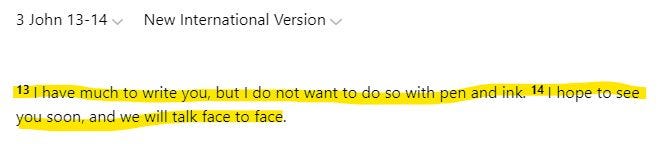
The face to face may feel uncomfortable to speak the truth or even to be yourself. But the social face is far easier to be misinterpreted. Take a little time to have some face to face with people around you. Also, take a little extra time thinking through what you are trying to say when posting on social media. It’s real people, with real hearts, who are out there reading.
Speak the truth… and do it in love.
Thanks for Listening,
Starla

