
Song for you
Lyrics from this song that hit:
Some want Christ as a cure, not King,
want the cross for protection, not the cost that it brings.
Want grace when the consequence walks through the door,
but holiness? Suddenly nobody’s sure.
Want “Lord, forgive me,”
not “Lord, refine me.”
Want “come and save me,”
not “come redefine me.”
Want Heaven behind them when battles begin,
but don’t want Heaven touching the places within.
That’s the part nobody puts in the chorus,
we love when He’s for us, get quiet when He forms us.
Thoughts I am thinking
I’ve had a recurring thought lately, pondering the nature of suffering and hardship. In a recent series, I touched on this by trying to answer what ‘legitimate suffering’ actually is—because, at some point, we have to learn to grow through what we go through.
As I’ve continued to reflect, another question has taken hold: How has the enemy duped us into believing that knowing God means we should be ‘living our best life’ right now?
That false expectation subtly shifts our perspective, leading us to ask, ‘Isn’t God unfair if we have to go through hard things?’ It creates an underlying accusation toward the Lord regarding our circumstances, alongside another common grievance—that God’s people don’t care to help those who are hurting.
Yet, all throughout Scripture, we see the exact opposite pattern: it is precisely in the deepest, hardest places that people actually found God.
Paul, at the time, thought he was doing God’s work by chasing down the Christians to imprison or kill them. He was encountered by the Lord Jesus.
Now Saul was still breathing threats and murder against the disciples of the Lord. He went to the high priest 2 and requested letters from him to the synagogues in Damascus, so that if he found any men or women who belonged to the Way, he might bring them as prisoners to Jerusalem. 3 As he traveled and was nearing Damascus, a light from heaven suddenly flashed around him. 4 Falling to the ground, he heard a voice saying to him, “Saul, Saul, why are you persecuting me?” 5 “Who are you, Lord?” Saul said.
Acts 9:1-9
“I am Jesus, the one you are persecuting,” he replied. 6 “But get up and go into the city, and you will be told what you must do.” 7 The men who were traveling with him stood speechless, hearing the sound but seeing no one. 8 Saul got up from the ground, and though his eyes were open, he could see nothing. So they took him by the hand and led him into Damascus. 9 He was unable to see for three days and did not eat or drink.
Saul was struck with blindness. Modern-day Christians would fuss right here. Without the context of the story, we would consider it unfair. Imagine being in this position. You are blind. The men travelling with you, perhaps your “friends,” led you to a town nearby and, for all we know, left you there. You are now alone, blind, and not eating or drinking.
We have no idea what he was thinking. Perhaps his thoughts were about, “What am I going to do?” Presumably, he would have only his mind and his wonder of what is going on, why this is happening to me, and now what? Will I ever see again?
We understand this, because this is how we function when we go through hard things.
- Now what?
- What is going on?
- Why is this happening?
- Will it always be this way?
- And most likely – GOD HELP ME!
So, why was he made blind?
Saul needed a perspective change. This is what all hard things come to do. Hard things come to change how we see God, people, and even ourselves.
God would send a man, a Christian, to pray for Saul’s eyes to open. But notice what Saul was doing…
There was a disciple in Damascus named Ananias, and the Lord said to him in a vision, “Ananias.”
Acts 9:10-12
“Here I am, Lord,” he replied. 11 “Get up and go to the street called Straight,” the Lord said to him, “to the house of Judas, and ask for a man from Tarsus named Saul, since he is praying there. 12 In a vision he has seen a man named Ananias coming in and placing his hands on him so that he may regain his sight.”
Saul was praying. He knew where to get help. He wasn’t asking for some men and women to come save him and take care of him. He was praying. Praying until he saw a vision of what would come.
Saul didn’t respond like a leper.
Lepers were a sect of people who were considered unclean or contaminated because of their skin conditions. They were to behave in a certain way.
- Wear torn garments – basically looking like the living dead.
- Uncovered heads – unkempt hair – a sign of their isolation and distress
- Cover their lower faces – like wearing a mask
- Crying out their condition – unclean, unclean! So that others would not come near.
- They lived outside the city
- They roamed about begging
Some Christians live in a state of spiritual leprosy that causes them to view their suffering as unfairness.
- Distanced by bitterness – complaining keeps them offended, full of self-pity, and bitter toward God
- Desperation is loud, but devotion is lean – they lament and beg but miss the relational communion with God and His body
- God is used as a tool rather than the object of devotion. Praise is absent.
- What the Circumstances are is more important than their character – they miss the formation of Christ within and would rather just not go through this, whatever this is
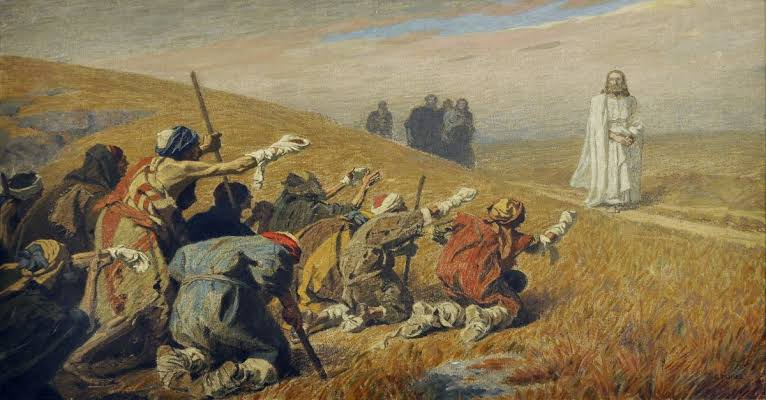
In Luke 17:11-19, Jesus encountered 10 lepers. They called on Him
“Jesus, Master, have mercy on us!”
He told them to go show themselves to the priests. As they went, they were cleansed.
15 But one of them, seeing that he was healed, returned and, with a loud voice, gave glory to God. 16 He fell facedown at his feet, thanking him. And he was a Samaritan.17 Then Jesus said, “Were not ten cleansed? Where are the nine? 18 Didn’t any return to give glory to God except this foreigner?” 19 And he told him, “Get up and go on your way. Your faith has saved you.”
Luke 17:15-19
ONE returned to Him to give God glory. All came to Him; 9 were transactional, one was relational.
This shows us how often this kind of attitude toward God is prevalent. Could it be 90% of people relate to God on a transactional basis? WOW! Will you be in the 10%? Will you be a tithe to the Lord? A living offering of praise!
Now back to Saul and the man whom God was sending.
He was not without some trepidation. Saul was a man killing and rounding up Christians. Ananias was apprehensive. But he did what the Lord asked of him.
“Lord,” Ananias answered, “I have heard from many people about this man, how much harm he has done to your saints in Jerusalem. 14 And he has authority here from the chief priests to arrest all who call on your name.” 15 But the Lord said to him, “Go, for this man is my chosen instrument to take my name to Gentiles, kings, and Israelites. 16 I will show him how much he must suffer for my name.”
Acts 9:13-16
God would shift Saul’s perspective; he would become a chosen instrument for God. And notice that this was not now; it would happen in and through an easy life. No, it would be through much suffering.
Be careful that you do not call God unfair, act like a leper, or accuse His people of being uncaring or uncompassionate. For perhaps you do not know what you are being called to. Are you praying and praising? Praising is very hard to do when you are full of bitterness. Praising requires a death of self. If people don’t seem to be helping, ask God what He is doing, wait for Him and the vision because His people are to go where He goes, do what He does, and move when He says move. To require otherwise is to accuse his people and desire to control your outcomes and circumstances rather than to desire Him above all else.
PS. Let me just say, “Yes, people sometimes are selfish, they don’t want to help, and they are not caring.” However, God is still God, and if He intends to send someone to you. He will.
May we be people who are looking for what God is doing!
Worship the King.
Praise Him for His goodness.
Thank Him for all He has done.
Thanks for listening,
Starla


One Comment Add yours